🥄 Mediation: Competitive Spoon Balancing
Erinnerst du dich an die geheimnisvolle Idee aus der Digital Detox Challenge? Hier erfährst du, worum es wirklich geht.
📋 Aufgabenstellung
Lies dir den Text über Competitive Spoon Balancing genau durch und beantworte dann die Fragen auf Deutsch. Du musst nicht in ganzen Sätzen antworten, aber ein Wort ist nicht genug.
📰 Der Text
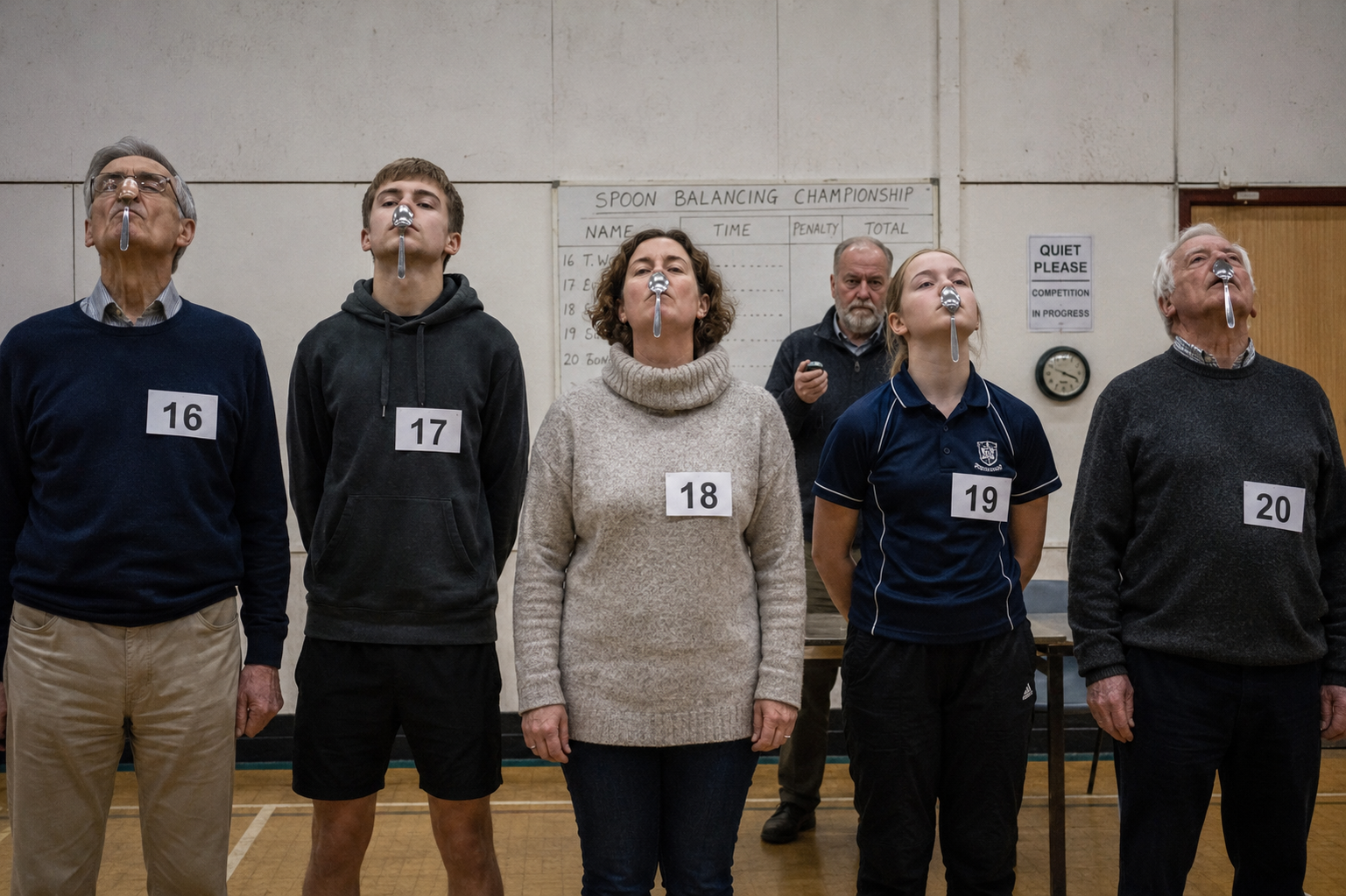 The "Spoon Balancing Championship" — as serious as it sounds
A staged photo for a made-up sport. The seriousness on their faces is the whole joke.
The "Spoon Balancing Championship" — as serious as it sounds
A staged photo for a made-up sport. The seriousness on their faces is the whole joke.
Competitive Spoon Balancing: Britain's Strangest New Trend?
Have you ever balanced a spoon on your nose just for fun? A small group of friends in Yorkshire has turned this silly party trick into a real competitive sport — and it is becoming surprisingly popular.
The rules sound simple, but they are not easy. Competitors must balance a smooth, curved spoon on one part of their body — usually the nose or the chin — for at least sixty seconds, without using their hands at all. The spoon has to stay completely still; if it falls, the round ends immediately. A full competition usually takes about two hours, with several short rounds instead of one long one.
The sport started about three years ago as a joke between two bored, tired office workers during their lunch break. Today there are approximately 150 official clubs across the country, and the number of members has increased every single year since then — roughly 4,000 people now compete regularly. Serious competitors train at least twice a week, usually in small, chilly village halls after school or work.
Interestingly, club organisers say that screen time among regular members has clearly decreased. Many players explain that balancing a spoon needs total concentration, which leaves no room for checking a phone at the same time.
So who actually does this? According to a recent survey, roughly half of all competitors are patient, easily bored teenagers looking for a new kind of challenge. The other half are calm, quietly competitive adults, including a surprising number of retired teachers. "You need a steady hand and a strange sense of humour," says club founder Priya Shah. "It sounds ridiculous until you try it."
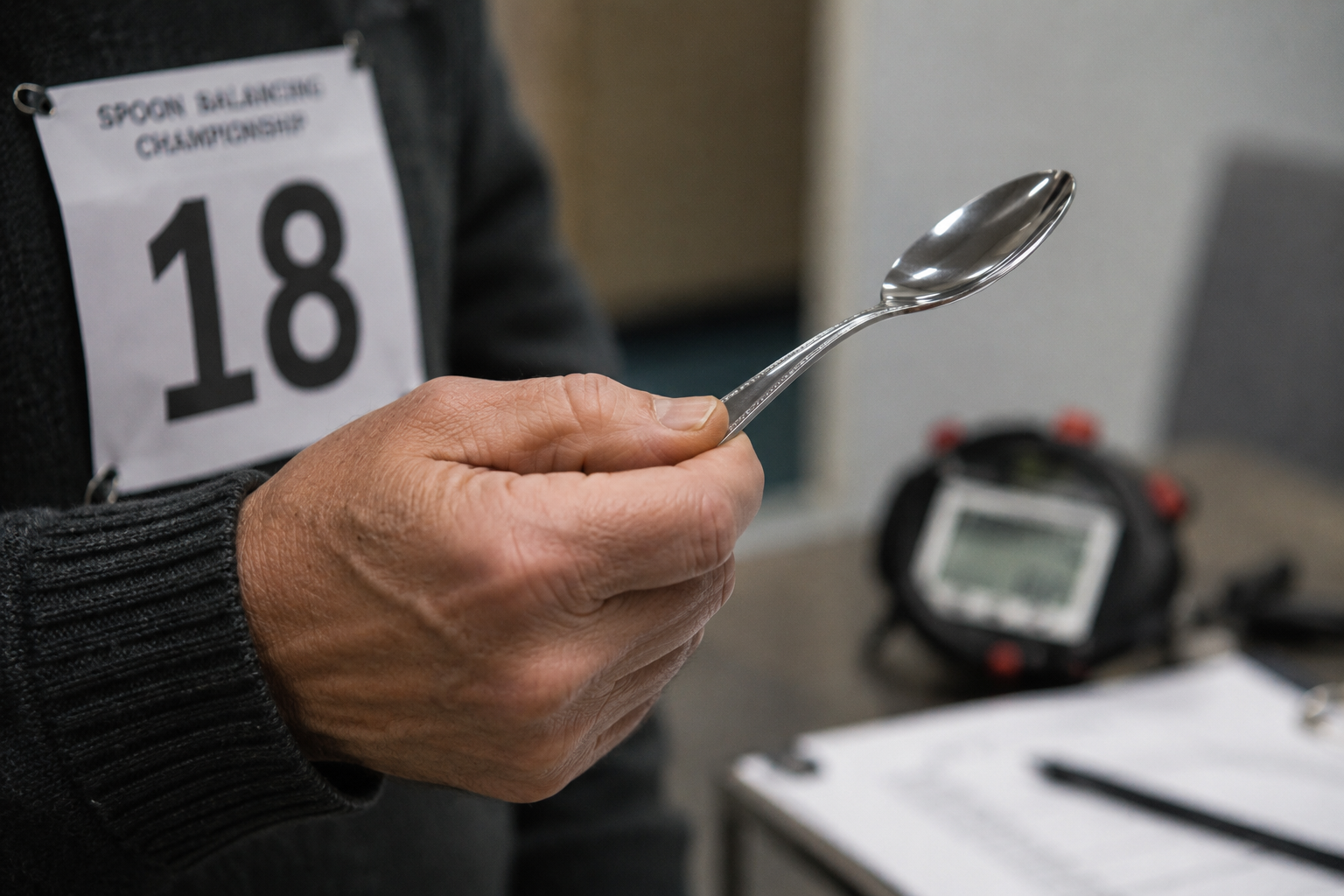 The most important piece of equipment: one ordinary spoon
No special gear needed — just patience, a very steady hand, and apparently a stopwatch.
The most important piece of equipment: one ordinary spoon
No special gear needed — just patience, a very steady hand, and apparently a stopwatch.
❓ Fragen zum Text
Wie hat der Trend "Competitive Spoon Balancing" laut Text angefangen?
Was genau müssen die Teilnehmer bei einem Versuch tun, und wie lange muss der Löffel dabei ruhig bleiben?
Wie hat sich die Anzahl der Clubs und Mitglieder seit dem Start entwickelt? Nenne auch die ungefähren Zahlen aus dem Text.
Was passierte laut Text mit der Bildschirmzeit der Teilnehmer — und was ist nach Meinung der Organisatoren der Grund dafür?
Beschreibe die zwei Gruppen von Menschen, die laut Text hauptsächlich mitmachen. Nenne dabei auch die passenden Adjektive aus dem Text.
Wie oft trainieren ernsthafte Teilnehmer laut Text?
Was, glaubst du, meint Priya Shah mit "a strange sense of humour"? Und würdest du "Competitive Spoon Balancing" selbst ausprobieren? Begründe kurz.
Einreichen
Geschafft!
Jetzt weißt du, was hinter dem geheimnisvollen Eintrag in der Digital Detox Challenge steckt. Ob du es wirklich ausprobieren würdest, bleibt dir überlassen.